Samwell Tarly
A Feast for CrowsSamwell Tarly stands at the intersection of weakness and usefulness. Exhausted, frightened, and burdened by the expectations attached to the word “maester,” he nevertheless possesses the literacy and persistence that the Night’s Watch urgently lacks. His work among neglected books turns fragmentary lore into actionable knowledge about the Others, dragonglass, fire, and the need to burn the dead. By the end of the supplied episodes, Jon Snow sends him away from the Wall with Gilly so that he can continue this work at Oldtown and become a new maester.
Identity and Intellectual Calling
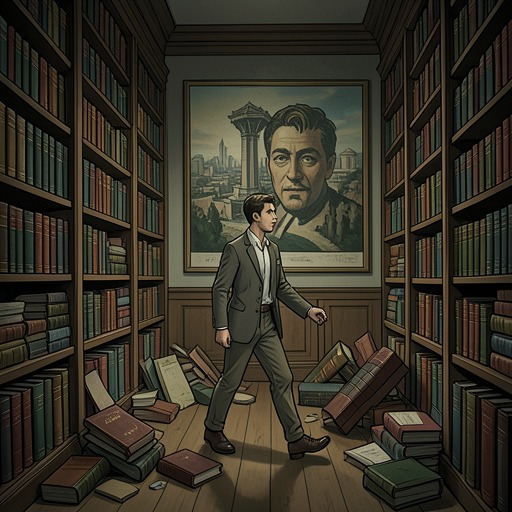
Samwell’s defining strength is not martial prowess but an almost compulsive devotion to reading. In the vaults, dust irritates his raw, red eyes, yet he continues turning pages long after fatigue, hunger, and the small tallow candle beside him should have driven him to rest. He has not eaten properly since sharing bean-and-bacon soup with Pyp and Grenn, but every promise to stop after one more book, folio, or page is defeated by the next text beneath the pile. The scene presents learning not as a comfortable scholarly pastime but as physical labor undertaken at personal cost. His research also places him within the Night’s Watch’s difficult inheritance. While examining records about the Others, he discovers that the children of the forest once gave the Watch a hundred obsidian daggers each year during the Age of Heroes. The accounts disagree about whether the Others bring the cold or appear because the cold has come, and they preserve contradictory details about snowstorms, darkness, and the corpses they ride. Samwell does not dismiss these inconsistencies; he assembles the recurring elements into a usable pattern.
Knowledge of the Others
Samwell’s findings give the Night’s Watch more than legend. The Others’ armor is said to resist ordinary blades, while their swords are so cold that they shatter steel. Fire can dismay them, and they are vulnerable to obsidian. Samwell’s confidence in the last point is grounded in personal experience: he remembers stabbing an Other with a dragonglass dagger made by Jon Snow and seeing the creature melt away. The remembered encounter converts an old report into evidence tested by his own survival. His reading also identifies the danger posed by the dead. Some accounts describe Others riding dead bears, direwolves, mammoths, and horses; Samwell connects this tradition to the Other that killed Small Paul, whose mount was a dead horse. The books further warn that men who fall in battle against the Others must be burned, or the dead will rise again as their thralls. Even the uncertain references to giant ice spiders remain part of the threat’s expanding, only partly understood shape. Samwell finds one account claiming that the last hero slew Others with a blade of dragonsteel, supposedly because they could not withstand it. Jon Snow’s skeptical response exposes the limits of this discovery: ancient Valyrian blades alone will not solve the crisis, and Samwell has not yet learned who the Others are, where they come from, or what they want. Samwell asks for more time because hundreds of books remain unread, but Jon answers that there is no more time.
Command, Departure, and the Citadel
Jon’s decision transforms Samwell’s research into an assignment. Samwell is ordered to gather his things and leave with Gilly, initially misunderstanding whether he is being sent to Eastwatch or somewhere else before learning that the destination is Oldtown. The proposed route is dangerous and elaborate: Dareon will join them at Eastwatch, the Blackbird will carry them to Braavos, and from there they must arrange passage to Oldtown. The journey also carries a personal and moral problem. Samwell has said that he will claim Gilly’s baby as his own bastard, and Jon tells him that, if he still means to do so, Gilly and the child can be sent on to Horn Hill; otherwise, Aemon can find Gilly a servant’s place at the Citadel. Samwell’s immediate fear concerns the sea, especially because autumn is stormy and ships sink, but Gilly’s presence and the prospect of the child growing up safely help him accept the departure. He even imagines asking his mother and sisters to help Gilly, while considering whether a letter might spare him a separate journey to Horn Hill. Jon’s purpose is not to remove Samwell from useful work but to place that work where it can grow. Although Samwell has been ordered to practice archery with Ulmer, the effort leaves his shoulders aching and his fingers blistered; he remains a poor archer, even while improving enough to hit the target more often than not. Jon therefore distinguishes between the hundreds of Watchmen who can loose arrows and the handful who can read or write. The Citadel has parchment, ink, and longbows, and Jon expects Samwell to continue practicing there. Most importantly, Jon tells him to become his new maester, making literacy a form of service rather than an escape from duty.
Aemon’s Death and Samwell’s Grief
Samwell’s bond with Maester Aemon is given its fullest expression after Aemon’s death aboard the Cinnamon Wind, a swan ship from Tall Trees Town sailing off the southern coast of Dorne. Because there is no septon aboard to lead the prayers, Samwell assumes the task while wearing his blacks in the warm, muggy afternoon. At first he begins with the modest claim that Aemon was a good man, then corrects himself: Aemon was a great man. His eulogy gathers the dimensions of Aemon’s life into a public act of remembrance. Aemon was a maester of the Citadel, chained and sworn, a Sworn Brother of the Night’s Watch, a counselor to a dozen lord commanders, and an adviser to kings. Samwell recalls that Aemon could have been king but directed the crown to his younger brother instead. He also names Aemon as blood of the dragon and as a man whose long life was no less heroic for having lasted so long. The speech turns private affection into institutional memory. When Samwell declares that Aemon Targaryen’s watch has ended, Gilly repeats the words while rocking the babe. Kojja Mo echoes them in the Common Tongue of Westeros and then repeats them in the Summer Tongue for the assembled crew. Samwell bows his head and weeps so violently that his whole body shakes; Gilly stands beside him and lets him cry on her shoulder, with tears in her own eyes. His grief is therefore not merely a pause in his duties. It confirms the emotional inheritance he carries from Aemon into the uncertain future at Oldtown.
Objects, Identity, and Narrative Significance
Samwell’s world is organized by objects that connect knowledge, danger, and belonging. The glass candles of the Citadel are said to have been brought from Valyria a thousand years before the Doom; four are rumored to exist, one green and three black, each tall and twisted. Their secrecy and uncertain history make them emblems of knowledge that survives institutions without being fully understood. The Citadel’s initiation ritual requires an acolyte to keep vigil in darkness with an obsidian candle, whose sharp ridges can cut the fingers of those foolish or stubborn enough to try lighting it. At Oldtown, Archmaester Marwyn’s black candle makes that mystery material. It is three feet tall, slender as a sword, ridged, twisted, and glittering; its flame does not flicker when the door slams, and its light makes whites shine like fresh snow, yellows like gold, and reds like flame while turning shadows into apparent holes. Marwyn explains that it is obsidian, or dragonglass, and that it burns without being consumed. For Samwell, such an object stands beside the books as another surviving channel from the deep past, linking the Citadel’s scholarship to powers that the written record only partially contains. Samwell’s importance is consequently an inversion of the conventional warrior’s journey. He is repeatedly reminded of bodily fear, failed archery, hunger, and exhaustion, yet these apparent deficiencies coexist with the courage to face an Other and the discipline to continue reading when no immediate reward is visible. His aliases, “Sam the Slayer” and “Slayer,” preserve the contradiction: a man who feels unsuited to violence becomes valuable because he can remember what violence cannot explain, interpret the records left by earlier ages, and carry that knowledge toward the institution that may teach him to serve as a maester.